> ## Documentation Index
> Fetch the complete documentation index at: https://www.offlineprotocol.com/docs/llms.txt
> Use this file to discover all available pages before exploring further.
# Architecture
> This system enables trustless, onchain location verification through a decentralized operator network. It combines client-side latency measurement, operator validation, and EigenLayer security guarantees.
## Technical Components
{" "}
- Connects to operators over WebSocket.
-
Sends ping and ack messages.
- Provides claimed coordinates for verification.
{" "}
- Registers as a decentralized witness.
- Timestamps packets with nanosecond precision.
- Computes geodistance (Haversine formula).
- Validates RTT against theoretical latency bounds.
-
Signs & submits results to
HelloWorldServiceManager.
{" "}
-
Service Manager: Manages verification tasks & operator
responses.
-
Delegation Manager & AVS Registry: Handle operator
staking & registration.
-
ECDSA Registry: Validates operator signatures.
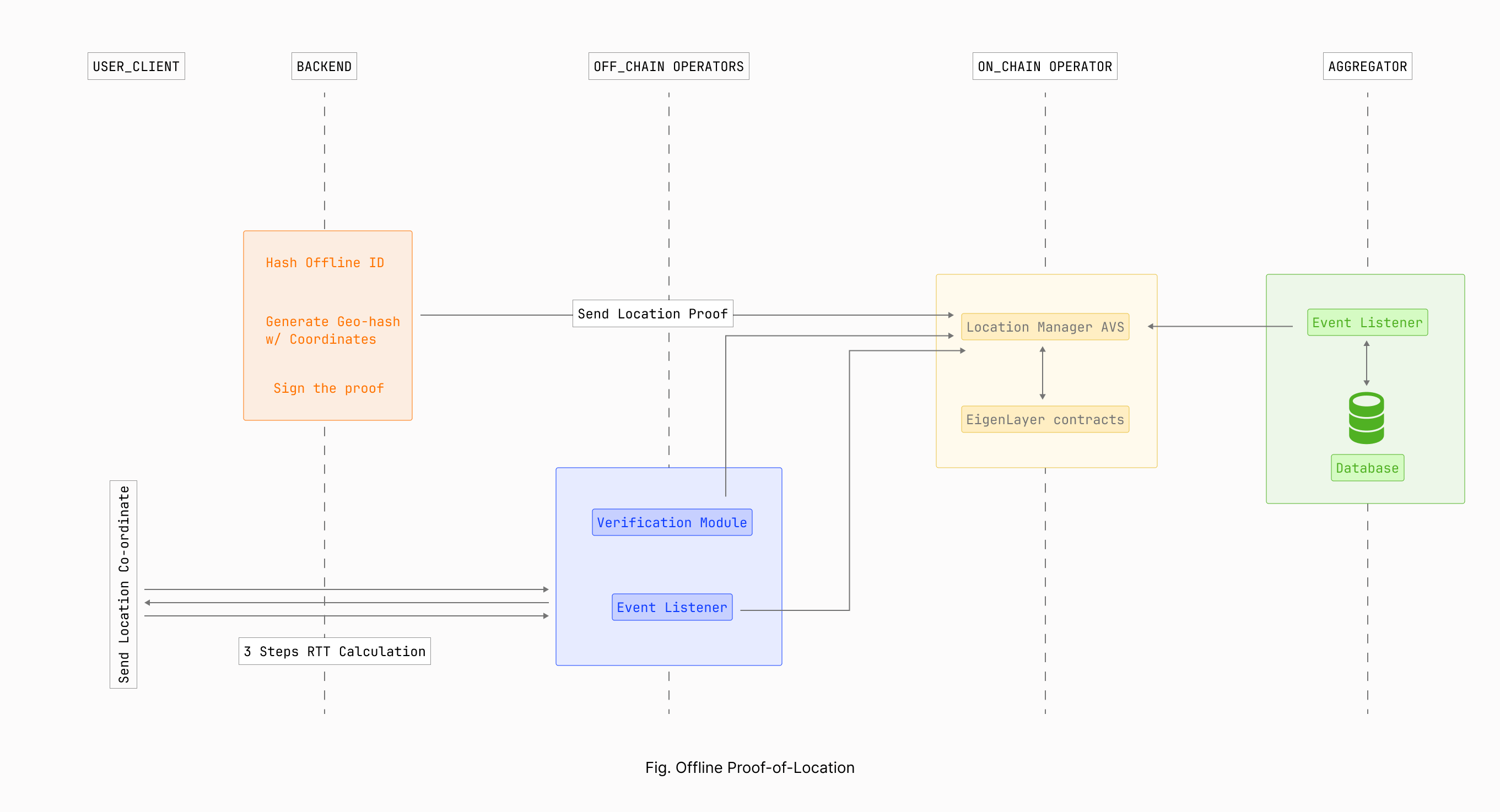 *Figure: POL Architecture*
## System Flow
### 1. Commitment Creation
* Client → Backend: Requests geohash commitment of claimed location.
* Backend → Contract: Submits the commitment.
### 2. Operator Discovery
* Backend → Client: Returns list of registered operators.
* Operators: Act as decentralized witnesses.
### 3. Connection Establishment
* Client Frontend: Opens WebSocket connections with operators.
* Each connection enables latency-based verification.
### 4. Ping / Pong Exchange
* Client → Operator: Sends a ping with claimed coordinates.
* Operator: Records timestamp, saves claim, responds with pong.
### 5. Ack for RTT Measurement
* Client → Operator: Sends ack message.
* Operator: Calculates RTT and compares to expected latency.
### 6. Location Verification
* Operator computes:
* Geodistance (Haversine formula)
* Min RTT (speed-of-light bound)
* Actual RTT (measured)
If within tolerance → Claim is valid\
If out of bounds → Claim is rejected
### 7. Onchain Response
* Operator → Contract: Signs result and calls `respondToTask`.
* Submission includes metadata, claim, and verification status.
### 8. Aggregation (Indexer Layer)
* Collects responses from multiple operators.
* Aggregates into a final proof.
* Publishes proof onchain for smart contracts to consume.
*Figure: POL Architecture*
## System Flow
### 1. Commitment Creation
* Client → Backend: Requests geohash commitment of claimed location.
* Backend → Contract: Submits the commitment.
### 2. Operator Discovery
* Backend → Client: Returns list of registered operators.
* Operators: Act as decentralized witnesses.
### 3. Connection Establishment
* Client Frontend: Opens WebSocket connections with operators.
* Each connection enables latency-based verification.
### 4. Ping / Pong Exchange
* Client → Operator: Sends a ping with claimed coordinates.
* Operator: Records timestamp, saves claim, responds with pong.
### 5. Ack for RTT Measurement
* Client → Operator: Sends ack message.
* Operator: Calculates RTT and compares to expected latency.
### 6. Location Verification
* Operator computes:
* Geodistance (Haversine formula)
* Min RTT (speed-of-light bound)
* Actual RTT (measured)
If within tolerance → Claim is valid\
If out of bounds → Claim is rejected
### 7. Onchain Response
* Operator → Contract: Signs result and calls `respondToTask`.
* Submission includes metadata, claim, and verification status.
### 8. Aggregation (Indexer Layer)
* Collects responses from multiple operators.
* Aggregates into a final proof.
* Publishes proof onchain for smart contracts to consume.