Drone swarm communication that survives GPS denial and lost links
A multi-hop mesh network between drones, ground robots, and autonomous vehicles with no ground station dependency. Peer discovery, capability invocation, and offline authentication between units in GPS denied environments. Live on 350,000+ devices across 80+ countries.
Coordination range grows with unit count, not radio power
BLE to WiFi Direct switch with no coordination gap
Routing follows radio adjacency, not position
The same mesh runs across 80+ countries
Autonomy programs fail on coordination, not compute
Fleet coordination collapses off-link
When vehicles lose the ground station, they lose each other. Formation, tasking, and deconfliction stall until the link returns, and the mission does not wait.
GPS-denied is a procurement requirement now
RFPs specify operation under jamming and interference as a baseline. Architectures that assume positioning and connectivity do not clear evaluation.
Single-transport comms are a single point of failure
One radio, one failure mode. Interference on the operating band takes the whole fleet's coordination down with it.
Cloud round-trips add latency and a dependency
Routing vehicle-to-vehicle decisions through a data center adds seconds where milliseconds matter, and a dependency the environment will cut.
What the mesh replaces
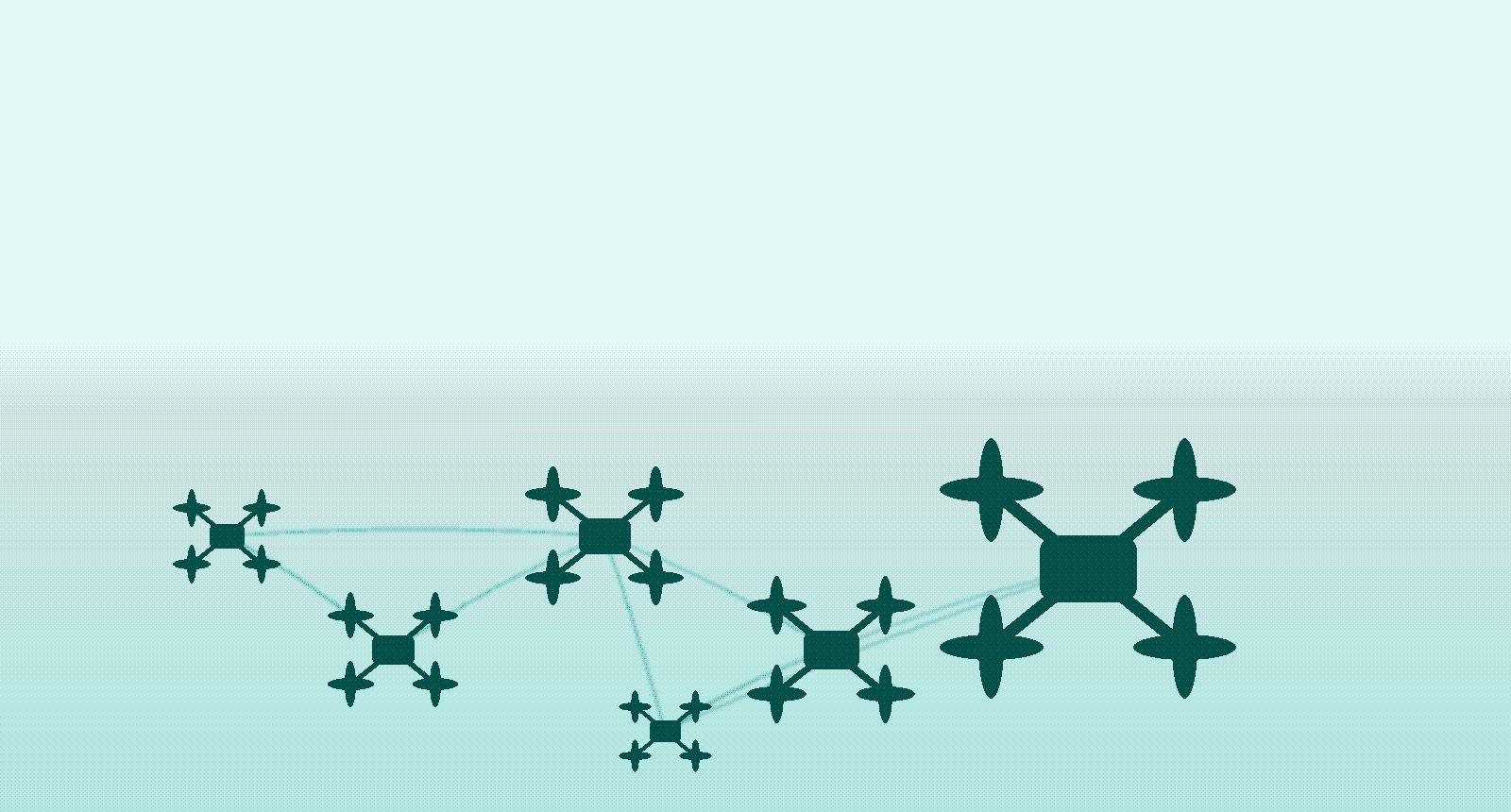
Vehicle-to-vehicle coordination with no ground station
DORS forms a multi-hop mesh between units over BLE, WiFi Direct, and any available link, with automatic failover and sub-second transport switching. The formation keeps coordinating when every external link is gone.

Peer discovery and capability invocation between units
One drone advertises a sensor, another invokes it. Service Discovery gives every unit a request/response interface to every capability within 8 hops, no tasking server in the loop.

Units authenticate each other in the field
OfflineID gives each unit an Ed25519 identity verifiable device-to-device with zero connectivity. A vehicle joining the formation proves who it is without phoning home. Rotation and revocation anchor on-chain.
Post-mission analysis from opt-in telemetry
A single event stream records transport-state transitions, routing decisions, and capability changes on-device during the mission, then syncs when a link returns. Nothing is emitted unless your app installs a sink.
What you can build for GPS denied swarms
Concrete autonomy capabilities you can integrate today on the SDK primitives, no named-customer required.
You can build a GPS denied swarm that keeps its formation
Wire DORS into your companion compute and units route vehicle to vehicle over BLE and WiFi Direct. When the ground link drops and positioning is jammed, the swarm keeps coordinating on radio adjacency alone, relaying up to 8 hops.
You can build cross-vehicle sensor sharing
One drone advertises a thermal or lidar capability through Service Discovery, and any unit within 8 hops invokes it request/response. No tasking server sits in the loop, so a payload sensor becomes a shared resource across the whole autonomous fleet.
You can build field enrollment for units that join mid-mission
A vehicle joining the formation proves who it is with an Ed25519 OfflineID verified device-to-device, zero connectivity required. Provision fleet identities up front and a new unit authenticates on the spot before it relays a single message.
Why a mesh network is the answer to GPS denied operations
Most swarm architectures route every inter-vehicle message through a ground control station. That makes the station a single point of failure and the datalink a hard range limit. A multi-hop mesh network inverts the model: every drone and robot is also a router, traffic hops vehicle to vehicle up to 8 hops, and the formation stays coordinated as long as any radio path exists between members.
Because routing follows radio adjacency rather than position, jammed or spoofed GPS has no effect on message delivery. Units find each other's capabilities through Service Discovery and verify each other with Ed25519 offline identities, so a vehicle joining the formation proves who it is with zero connectivity.
The same primitives carry peer-to-peer coordination between on-device AI agents, which is what autonomy stacks increasingly are. If your fleet runs models at the edge, the mesh is the coordination layer under them.
A sensor invocation across the swarm
A caller drone console invokes a thermal sensor three hops away over a GPS denied drone swarm mesh network, relaying drone to drone with no ground station and no internet.
Figure 1. The caller discovers the sensor capability three hops away, authenticates the provider with OfflineID, and invokes it request/response over the mesh. No ground station, no GPS, no internet in the loop.
The primitives behind swarm autonomy
Topology-based routing survives GPS denial
DORS routes by radio adjacency, not position. Jammed or spoofed positioning has no effect on discovery, invocation, or message delivery between units.
How mesh networking works →Peer discovery and capability invocation between units
Every unit gets a request/response interface to every capability within 8 hops. Advertise a sensor, invoke it from another vehicle, with acknowledgment and retry at the transport.
How service discovery works →Units authenticate each other in the field
Each unit carries an Ed25519 self-sovereign identity verifiable device-to-device with no connectivity. Rotation and revocation anchor on-chain when any node touches the internet.
How offline identity works →What your team can implement
Each capability is a shipped SDK primitive. Follow the link to the reference.
Vehicle-to-vehicle mesh transport
Route coordination messages drone to drone with automatic failover.
→Capability advertising and invocation
Expose a sensor or actuator as a discoverable service on the swarm.
→Offline unit authentication
Verify a joining vehicle device-to-device with an Ed25519 OfflineID.
→Opt-in mission telemetry
Buffer routing and transport events on-device, flush when a link returns.
→Chunked payload transfer
Move sensor captures up to 100MB across the mesh in ordered chunks.
→Rust core on your compute
Run the SDK on companion and payload computers that host the Rust core.
→Encrypted coordination sessions
Every invocation runs inside an MLS-encrypted, authenticated session.
→Scope a fleet pilot
A 6 to 10 week pilot against your vehicles and your environment.
→How a pilot runs
6 to 10 weeks, scoped up front, no open-ended commitments.
The SDK goes onto your companion or payload compute. Units join the mesh and authenticate each other with fleet-provisioned OfflineIDs.
A defined offline scenario in your environment: links cut, positioning denied, coordination and capability invocation running mesh-only.
Success criteria agreed before week one, evaluated against the opt-in telemetry record: delivery rates, failover times, hop counts, routing decisions.
Robotics FAQ
How do drone swarms communicate in GPS denied environments?
Over a device-to-device mesh instead of a ground link. DORS routes by radio adjacency, not position, and relays messages vehicle to vehicle up to 8 hops, so jammed or spoofed positioning does not stop discovery, invocation, or message delivery between units.
Does the mesh depend on GPS?
No. Routing is topology-based, not position-based. Units coordinate by radio adjacency, so jammed or spoofed positioning does not affect message delivery or service invocation.
What is a mesh network for drones and ground robots?
A network where every unit is also a router. Instead of each vehicle holding a link to a ground station, units forward traffic for each other over BLE and WiFi Direct, so the swarm carries its own connectivity and coordination range grows with the number of units, not with radio power.
What is the coordination latency between units?
Direct-link messages travel at transport speed with no server round-trip. Failover between transports completes in under a second, and multi-hop relay adds per-hop forwarding only.
How do units authenticate without a network?
Each unit carries an Ed25519 OfflineID verified device-to-device with trust-on-first-use. Keys never leave the device. Revocation propagates when any node touches the internet.
Can we run this on our existing compute?
The core is Rust with a React Native binding for iOS and Android. Companion and payload computers that can run the Rust core can join the mesh directly.
How does a pilot work?
A 6 to 10 week scoped pilot against your fleet, your environment, and success criteria we agree up front. Contact us to scope it.
Does the mesh interfere with our existing radios?
DORS runs over BLE and WiFi Direct, standard consumer bands, alongside whatever mission radios you already fly. It adds paths; it does not replace or retune the links you have.